Am I?
Many people feel attracted to people of the same sex, and wonder whether this means that they are gay. For some people these feelings can be very intense and alienating, whilst some people are more comfortable with these feelings earlier on. Some people who ask themselves the question "am I gay?" are indeed attracted primarily to members of the same sex, and go on to have gay sexual relationships. People sometimes find that their feelings change over time.
Some people are bisexual, meaning they are attracted to both men and women, and at different times, have relationships with both. Some people are not attracted to anyone and wonder if this is a sign that they are gay. Often it is only time that will resolve these uncertainties.
When?
There is no simple answer to this question, as it varies from person to person. Becoming aware of gay or bi-sexual feelings often happens gradually, it may not be something you can initially put a name to, and it can feel very confusing.
During research carried out with young gay men in the UK, the men interviewed described a set of feelings which they gradually realised made them 'different' in some way, feelings they thought maybe every teenage boy has.
“I thought, well, this is just the phase bit. Sooner or later I'm going to start finding women attractive. I never did. As I became more attracted to men, and I still wasn't getting attracted to women, I thought, shit, you're gay. And it was really quite a shock when it hit me.”Luke
With time, someone who is gay will realise that not only are they sexually attracted to members of the same sex, but that this attraction is not transitional, or as often described 'just a phase'. This realisation could come at any time during their lives. Many people become aware of gay feelings during their teenage years, as this is when they begin to learn more about their sexuality and identity. However, the difficulties associated with accepting these feelings and coming out mean that many gay people don't identify themselves as gay until later on in life.
How?
There is no simple answer to the question, 'Are some people born lesbian or gay?' There are some theories that stress biological differences between heterosexual and homosexual adults, suggesting that people are born with their sexuality already determined.
he American researcher Dean Hamer published research that seemed to prove that homosexual orientation could be genetically transmitted to men on the x chromosome, which they get from their mothers. However when this study was duplicated it did not produce the same results. A follow-up study which Hamer collaborated on also failed to reinforce his earlier results.
Subsequent research published by George Rice and George Ebers of the Universty of Western Ontario has cast doubt on Hamer's theory. Rice and Ebers' research also tested the same region of the x chromosome in a larger sample of gay men, but failed to find the same 'marker' that Hamer's research had found. Claims that the part of the brain known as the hypothalamus is influential in determining sexual orientation, have yet to be substantiated.
“How can science tell you what I am? I mean I've had boyfriends, and was happy with them, had girlfriends and may have boyfriends again for all I know. If it's a gay gene what's going on? Is it just turning itself on and off in my head? It doesn't feel like biology it feels like love.”Jo
Psycho-social explanations offer a variety of factors that could contribute to the development of a person's homosexuality. For example, a female dominated upbringing in a gay man's past, with an absence of a male role model. Others stress adherence or deviance from conformity to gender roles, and individual psychological makeup.
While none of these factors alone completely answers the question 'what causes homosexuality?', they rule out some things. For example, lesbian and gay young people are not 'failed' heterosexuals. Also, homosexual partners are generally of the same age proving wrong the assumptions that young people are 'turned gay' by older people.
What is clear is that people's behaviour is influenced by their family environment, their experiences and their sense of themselves. Beliefs about sex are initially shaped by family values. Later on these beliefs may be shaped by pleasant and unpleasant experiences of sex and also shape their choice of activities and partners. Throughout their life a person's sense of who and what they are has a strong impact on their sexual development and experience.
Can I Stop?
There is now growing general support for the belief that sexuality is pre-determined, though may change over time. However, many people are interested in whether sexuality can be altered solely by a person's desire to change. Organisations that claim to help homosexuals attempt to change their sexuality can be generally divided between those that use psychological 'reparative' methods and those that use religious 'healing' methods.
Some people believe homosexuality is an illness and believe it can and should be cured. Many of these 'cures' revolve around psychological therapies (often called reparative therapy) which endeavour to re-orient a homosexual sexuality to heterosexual. Although there is little scientific data to evaluate, what is available seems to indicate that reparative therapy is ineffective. The American Psychological Association (APA), the world's largest association of psychologists has stated that:
“Homosexuality is not a mental disorder and the APA opposes all portrayals of lesbian, gay and bisexual people as mentally ill and in need of treatment due to their sexual orientation.”
As with reparative therapy there has been little to no scientific evaluation of the healing and prayer techniques used to attempt to change people. What evidence is available suggests that the success of these techniques is restricted to three areas:
Convincing bisexual people to limit their sexual activities to members of the opposite sex.
Convincing homosexual people to become celibate.
Convincing gay men and lesbian women to attempt to maintain heterosexual relationships, whilst retaining their homosexual orientation.
Tellingly, two founders of a ministry established to 'heal' homosexuals later described their programme as 'ineffective ... not one person was healed'.
The subject of 'curing' homosexuality became a politically charged debate in America, with Christian political organisations promoting the theory that homosexuality can be changed through force of will alone. They claim that 'thousands are leaving their homosexual identity for sexual celibacy, and even marriage'. Alternatively, gay and lesbian rights organisations would argue that these views misunderstand what it means to be gay, and amount to discrimination against gay and lesbian people. Furthermore, the American Psychological Association has carried out a systematic review, which not only concludes that psychological interventions are not effective at changing sexual orientation, but they can also cause significant harm.

My Life And Death
Monday, 8 October 2012

Aaron Fav Fictional Characters - Burt Gummer
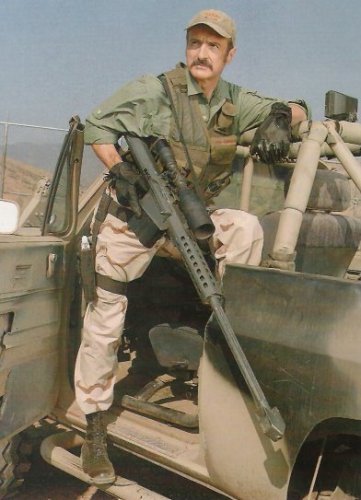
Burt Gummer is a fictional character, played by actor Michael Gross, from the Tremors film series and the short lived SciFi Channel TV program of the same name. Appearing in Tremors, Tremors 2: Aftershocks, Tremors 3: Back to Perfection, and most episodes of the TV series, Burt Gummer is a firearms enthusiast and a paranoid, survivalist, right-wing, anti-government, gun nut. He and his former wife, Heather Gummer (played by Reba McEntire), were the first persons in the film series to directly kill a Graboid. He has an "overkill" approach to trouble and takes himself deadly seriously. Although he is only the central character in Tremors 3 and the TV series, his eccentric personality has made him a favorite among Tremors fans and the de facto star of the franchise, along with the vicious Graboids who oppose him. His ancestor, Hiram Gummer (also played by Gross), appears in Tremors 4: The Legend Begins.
In an interview, when asked, "Did you ever think that Burt would become part of a franchise?" Gross replied, "I knew it was an intriguing character." The actor goes on to assert, "Well, I love Burt. You know, there's a little scene in the third movie that is quintessential Burt. Burt is so fear-driven that he's a paranoid, ultimately, but a comic paranoid. And there's a scene in which he goes up to his house to punch in his keycode on his pad. But before he does, he takes a good look around and stands in front of the pad - there's nobody there for miles! - but he blocks the keypad with his body. Because Burt would rightly assume that there's somebody in the hills with a high-powered telescope who wants his keypad information, wants the code. Now that's the level of paranoia. Does it get funny? Yeah, because it's just so over the top. I love that. I love that about him. It's inherent in the fact that he has no sense of humor. It's because he doesn't consider life funny that we find him funny and his extremes which are so marvelous in human behavior....And one of the great things I love about Burt and what the writers do with him is he will prepare himself in certain ways and then we find out that, once again, he's not prepared because the animals have mutated in such a way that they've found a way to get around his best defenses. He couldn't possibly plan for every contingency and he thinks he has."
Although very little is known about Burt's past, it has been hinted that he might've been involved in the military, and at the very least possesses extensive knowledge of military history, tactics, and protocol. Burt has also had an affection for guns since middle-school, evidenced by his telling Desert Jack that he "converted [his] BB gun to automatic by the eighth-grade." While he is very fond of his firearms, he is also strict about personal safety and care in the handling of firearms.
Burt settled in the town of Perfection with his wife, Heather (Reba McEntire), sometime before Tremors 1, a site they chose tactically due to its geographic isolation. It was later revealed in Tremors 4, however, that his ancestor Hiram Gummer (again played by Gross) inherited a silver mine in the town (which was named "Rejection" at the time), and went on to marry the local town-mistress. Stampede Entertainment's official website states that Hiram and his wife left in 1902 for San Francisco after a disagreement with Nevada bureaucrats over the date of the town's founding, and never returned (which may hint at the origins of Burt's anti-government sentiments). It may also simply be that Burt inherited the land, and given the choice, Burt & Heather located themselves in Perfection for the "geographic isolation".
Whether there is any direct connection between these events and Burt's choice to move to Perfection is unknown, but prior to the events of Tremors 3, Burt did possess an inheritance of silver bars from Hiram's ownership of the mine (as referenced in Tremors the Series). This massive inheritance also explains Burt's extensive weaponry and supplies, though some of the weapons may have been inherited as well, as Hiram developed a fondness for firearms over the course of Tremors 4.
In the first film, Burt was shown to be paranoid about surviving "World-War III", and his main cause as a survivalist. He had spent all of his years preparing for the possibility, building a stock of several years' worth of food and provisions in his home's underground bomb shelter. After the Graboid attacks of Tremors 1, Burt instead begins to worry less about World War III (possibly owing to the collapse of Soviet Russia, after which he sank into a deep depression as seen in Tremors 2), and becomes obsessed instead with Graboids, growing more obsessed with each new installment of the series, even having a massive underground concrete wall built to protect his compound. These obsessions and possibly the fear of the Graboids eventually cause his wife to divorce him sometime shortly before Tremors 2.
His regard to the final surviving albino Graboid from the end of Tremors 3 and the subsequent TV series, El Blanco, who is protected by his endangered species status (and inability to spawn the far more dangerous Shriekers, making him the only stable Graboid specimen ever found), is as something of a nemesis (their relationship was once compared to be somewhat like Captain Ahab & Moby-Dick), as Burt must balance his survival tactics with efforts to intentionally avoid harming the Graboid. Despite his animosity towards El Blanco, Burt has saved the Graboid's life on a few occasions, in the series premiere even begging the driven insane Graboid not to make him kill it, before destroying the machine driving it nuts. El Blanco also, if inadvertently, saved his life from an Ass Blaster when Desert Jack tricked it into eating the creature as it was about to kill Burt.
One controversy is how he gets his weapons and ammo, despite all of his guns being legal (except an SMG he is seen to own, though it may be a National Firearms Act registered weapon, and therefore lawful), the bullets for the Grizzly Big Boar and Barrett M82 .50 caliber BMG sniper rifle he wields are a topic that could be debated. How he obtained a minigun legally is also questionable. While it is possible he obtained them illegally, his repeated interactions with Department of the Interior official W.D. Twitchell in Tremors the Series made implications that Twitchell kept a close eye on all activity in Perfection valley, making it less likely that Burt accomplished illegal imports unnoticed. It is also possible that he undertook a special NFA process to purchase completely legal transferable title II weapons, which would include any of an array of sub-machine guns or even his minigun.
Burt has had many firsts and unique experiences with Graboids, having been the first to directly kill one via weaponry (the first was killed when it accidentally collided with a concrete wall at high speed), as well as being the only person to ever survive being eaten by a Graboid, having been eaten while inside a barrel; the Graboid was subsequently killed and cut open, allowing Burt to escape and survive. Burt has also probably killed more Graboids and their offspring than any other person, having taken out one in the first film, many of them with explosives in Tremors 2, having defeated an entire group of shriekers by himself during Tremors 2, another group of Shriekers at the start of Tremors 3, a number of the ass-blasters in Tremors 3, and a number of Shriekers in Tremors the Series. Recognized for his skill and expertise in the matter, W.D. Twitchell of the Department of the Interior often enlists Burt to deal with Graboid hatchlings in various populated areas of the United States when they occur.

Tremors (1990)
[Burt Gummer, with his wife Heather at his side, berates the dead monster fought off with their "family arsinal"]
Burt Gummer: Broke into the wrong God damn rec room, didn't ya you bastard!
[Burt Gummer looks at his bomb shelter for perhaps the last time]
Burt Gummer: Food for five years, a thousand gallons of gas, air filtration, water filtration, Geiger counter. Bomb shelter! Underground... God damn monsters.
Burt Gummer: No tracks, no sign, no spoor... you'd think after eating all those sheep they'd have to take a dump *some*place
Valentine McKee: Come on you two, let's go, we're headed for the mountains!
Burt Gummer: [Hefts bag of weapons] If that's how we're doin it, we're going prepared!
Valentine McKee: We can't hold still long! These things are damn smart! They're getting smarter by the minute!
Burt Gummer: That's fine!
[Holds up a stick of dynamite]
Burt Gummer: We got some new things to teach 'em!
[Burt cuts off a piece of fuse for a bomb for Earl]
Earl Bassett: What kind of fuse is that?
Burt Gummer: Cannon fuse
Earl Bassett: What the hell do you use it for?
Burt Gummer: My cannon!
Valentine McKee: What the hell's in those things, Burt?
Burt Gummer: A few household chemicals in the proper proportions.
Burt Gummer: [handing out weapons and refusing to give Melvin one] I wouldn't give you a gun if it were World War 3.
Valentine McKee: [speaking to Burt over a radio and is trying to tell him about the monsters] Burt, it's under the ground! It's an underground monster!
Burt Gummer: [over the radio, as a monster comes through his rec room wall] Jesus Chri...!
[transmission turns to static]
Tremors II: Aftershocks (1996)
Grady: [it's night, Grady and Earl are waiting on top of their stranded truck for Pedro to arrive, an explosion sounds in the distance]
[referring to Burt]
Grady: Jesus! He got another one.
Earl Bassett: That man never sleeps.
[two more explosions sound in the distance]
Burt Gummer: [over radio] Guys, Burt here. Doing a little night fishing. Got three of 'em on a cluster chare. I'd say we're about even now. Over.
Earl Bassett: Come on, Burt. This isn't a competition.
Burt Gummer: [over radio] Well, who's competing? I'm just saying the score is tied, that's all. Over.
Grady: Well, 'son', no it isn't, cuz we just caught a live one. How 'bout that.
Burt Gummer: [over radio] A live one? How in the hell...
Grady: Well, that's our little secret. Happy hunting, Burt.
[turns radio off]
Earl Bassett: [laughing] I'll bet that burned his skinny ass!
Burt Gummer: I am COMPLETELY out of ammo. That's never happened to me before.
[Burt has just blown up a Graboid]
Burt: Memo: 4 pounds of C-4 may be a bit -
[pebbles rain down onto his helmet]
Burt: excessive.
Burt Gummer: I feel I was denied critical need-to-know information.
[Upon being introduced to Burt's anti-tank rifle]
Earl Bassett: Man Burt, you put a whole new shine on the word 'overkill'.
Burt Gummer: When you need it, and don't have it... you sing a different tune.
Burt Gummer: I didn't know... how could I have known? I wanted maximum penetration!
Earl Bassett: [Looks at destroyed engine] Well, you got it.
Burt: It's gonna be big!
Grady: But is it gonna be today!
[hiding from the Shriekers, Earl, Grady, and Kate are on top of some containers, Burt is inside the scoop of a bulldozer]
Grady: Burt are you *sure* you don't have any more bullets? Did you check *all* your pockets?
Burt Gummer: You know, as I lie here, I can't help but notice... the reason I am out of nine millimeter rounds is that I was not properly briefed. And the reason for that is that this mission was not properly researched. If certain people had bothered to gather intelligence on the creatures before bumbling into the situation...
Earl Bassett: Burt, knock it off!
Burt Gummer: ...We wouldn't be down here with single-shot big bores when we should be packing full auto, preferably belt-fed!
[a Shrieker near Burt grunts loudly]
Burt Gummer: [to the Shrieker] Shut up!
Earl Bassett: Jesus, Burt! You smoked his ass!
Burt: Just doing what I can with what I got.
Burt Gummer: [Earl has set a bomb to blow up a garage containing the Shriekers] Earl! Earl, the bomb, how long did you set it for?
Earl Bassett: Oh, I... I don't know, I just punched in some numbers and threw it in the back of your truck!
Burt Gummer: [horrified] You WHAT? That's 2,5 tons of high explosives, Earl!
Earl Bassett: You mean that's not enough?
[panicking]
Earl Bassett: Oh Burt, don't tell me it's not enough!
Burt Gummer: Not enou... Never mind, just run! Run!
Burt Gummer: I feel I was denied critical NEED TO KNOW information.
In an interview, when asked, "Did you ever think that Burt would become part of a franchise?" Gross replied, "I knew it was an intriguing character." The actor goes on to assert, "Well, I love Burt. You know, there's a little scene in the third movie that is quintessential Burt. Burt is so fear-driven that he's a paranoid, ultimately, but a comic paranoid. And there's a scene in which he goes up to his house to punch in his keycode on his pad. But before he does, he takes a good look around and stands in front of the pad - there's nobody there for miles! - but he blocks the keypad with his body. Because Burt would rightly assume that there's somebody in the hills with a high-powered telescope who wants his keypad information, wants the code. Now that's the level of paranoia. Does it get funny? Yeah, because it's just so over the top. I love that. I love that about him. It's inherent in the fact that he has no sense of humor. It's because he doesn't consider life funny that we find him funny and his extremes which are so marvelous in human behavior....And one of the great things I love about Burt and what the writers do with him is he will prepare himself in certain ways and then we find out that, once again, he's not prepared because the animals have mutated in such a way that they've found a way to get around his best defenses. He couldn't possibly plan for every contingency and he thinks he has."
Although very little is known about Burt's past, it has been hinted that he might've been involved in the military, and at the very least possesses extensive knowledge of military history, tactics, and protocol. Burt has also had an affection for guns since middle-school, evidenced by his telling Desert Jack that he "converted [his] BB gun to automatic by the eighth-grade." While he is very fond of his firearms, he is also strict about personal safety and care in the handling of firearms.
Burt settled in the town of Perfection with his wife, Heather (Reba McEntire), sometime before Tremors 1, a site they chose tactically due to its geographic isolation. It was later revealed in Tremors 4, however, that his ancestor Hiram Gummer (again played by Gross) inherited a silver mine in the town (which was named "Rejection" at the time), and went on to marry the local town-mistress. Stampede Entertainment's official website states that Hiram and his wife left in 1902 for San Francisco after a disagreement with Nevada bureaucrats over the date of the town's founding, and never returned (which may hint at the origins of Burt's anti-government sentiments). It may also simply be that Burt inherited the land, and given the choice, Burt & Heather located themselves in Perfection for the "geographic isolation".
Whether there is any direct connection between these events and Burt's choice to move to Perfection is unknown, but prior to the events of Tremors 3, Burt did possess an inheritance of silver bars from Hiram's ownership of the mine (as referenced in Tremors the Series). This massive inheritance also explains Burt's extensive weaponry and supplies, though some of the weapons may have been inherited as well, as Hiram developed a fondness for firearms over the course of Tremors 4.
In the first film, Burt was shown to be paranoid about surviving "World-War III", and his main cause as a survivalist. He had spent all of his years preparing for the possibility, building a stock of several years' worth of food and provisions in his home's underground bomb shelter. After the Graboid attacks of Tremors 1, Burt instead begins to worry less about World War III (possibly owing to the collapse of Soviet Russia, after which he sank into a deep depression as seen in Tremors 2), and becomes obsessed instead with Graboids, growing more obsessed with each new installment of the series, even having a massive underground concrete wall built to protect his compound. These obsessions and possibly the fear of the Graboids eventually cause his wife to divorce him sometime shortly before Tremors 2.
His regard to the final surviving albino Graboid from the end of Tremors 3 and the subsequent TV series, El Blanco, who is protected by his endangered species status (and inability to spawn the far more dangerous Shriekers, making him the only stable Graboid specimen ever found), is as something of a nemesis (their relationship was once compared to be somewhat like Captain Ahab & Moby-Dick), as Burt must balance his survival tactics with efforts to intentionally avoid harming the Graboid. Despite his animosity towards El Blanco, Burt has saved the Graboid's life on a few occasions, in the series premiere even begging the driven insane Graboid not to make him kill it, before destroying the machine driving it nuts. El Blanco also, if inadvertently, saved his life from an Ass Blaster when Desert Jack tricked it into eating the creature as it was about to kill Burt.
One controversy is how he gets his weapons and ammo, despite all of his guns being legal (except an SMG he is seen to own, though it may be a National Firearms Act registered weapon, and therefore lawful), the bullets for the Grizzly Big Boar and Barrett M82 .50 caliber BMG sniper rifle he wields are a topic that could be debated. How he obtained a minigun legally is also questionable. While it is possible he obtained them illegally, his repeated interactions with Department of the Interior official W.D. Twitchell in Tremors the Series made implications that Twitchell kept a close eye on all activity in Perfection valley, making it less likely that Burt accomplished illegal imports unnoticed. It is also possible that he undertook a special NFA process to purchase completely legal transferable title II weapons, which would include any of an array of sub-machine guns or even his minigun.
Burt has had many firsts and unique experiences with Graboids, having been the first to directly kill one via weaponry (the first was killed when it accidentally collided with a concrete wall at high speed), as well as being the only person to ever survive being eaten by a Graboid, having been eaten while inside a barrel; the Graboid was subsequently killed and cut open, allowing Burt to escape and survive. Burt has also probably killed more Graboids and their offspring than any other person, having taken out one in the first film, many of them with explosives in Tremors 2, having defeated an entire group of shriekers by himself during Tremors 2, another group of Shriekers at the start of Tremors 3, a number of the ass-blasters in Tremors 3, and a number of Shriekers in Tremors the Series. Recognized for his skill and expertise in the matter, W.D. Twitchell of the Department of the Interior often enlists Burt to deal with Graboid hatchlings in various populated areas of the United States when they occur.
Tremors (1990)
[Burt Gummer, with his wife Heather at his side, berates the dead monster fought off with their "family arsinal"]
Burt Gummer: Broke into the wrong God damn rec room, didn't ya you bastard!
[Burt Gummer looks at his bomb shelter for perhaps the last time]
Burt Gummer: Food for five years, a thousand gallons of gas, air filtration, water filtration, Geiger counter. Bomb shelter! Underground... God damn monsters.
Burt Gummer: No tracks, no sign, no spoor... you'd think after eating all those sheep they'd have to take a dump *some*place
Valentine McKee: Come on you two, let's go, we're headed for the mountains!
Burt Gummer: [Hefts bag of weapons] If that's how we're doin it, we're going prepared!
Valentine McKee: We can't hold still long! These things are damn smart! They're getting smarter by the minute!
Burt Gummer: That's fine!
[Holds up a stick of dynamite]
Burt Gummer: We got some new things to teach 'em!
[Burt cuts off a piece of fuse for a bomb for Earl]
Earl Bassett: What kind of fuse is that?
Burt Gummer: Cannon fuse
Earl Bassett: What the hell do you use it for?
Burt Gummer: My cannon!
Valentine McKee: What the hell's in those things, Burt?
Burt Gummer: A few household chemicals in the proper proportions.
Burt Gummer: [handing out weapons and refusing to give Melvin one] I wouldn't give you a gun if it were World War 3.
Valentine McKee: [speaking to Burt over a radio and is trying to tell him about the monsters] Burt, it's under the ground! It's an underground monster!
Burt Gummer: [over the radio, as a monster comes through his rec room wall] Jesus Chri...!
[transmission turns to static]
Tremors II: Aftershocks (1996)
Grady: [it's night, Grady and Earl are waiting on top of their stranded truck for Pedro to arrive, an explosion sounds in the distance]
[referring to Burt]
Grady: Jesus! He got another one.
Earl Bassett: That man never sleeps.
[two more explosions sound in the distance]
Burt Gummer: [over radio] Guys, Burt here. Doing a little night fishing. Got three of 'em on a cluster chare. I'd say we're about even now. Over.
Earl Bassett: Come on, Burt. This isn't a competition.
Burt Gummer: [over radio] Well, who's competing? I'm just saying the score is tied, that's all. Over.
Grady: Well, 'son', no it isn't, cuz we just caught a live one. How 'bout that.
Burt Gummer: [over radio] A live one? How in the hell...
Grady: Well, that's our little secret. Happy hunting, Burt.
[turns radio off]
Earl Bassett: [laughing] I'll bet that burned his skinny ass!
Burt Gummer: I am COMPLETELY out of ammo. That's never happened to me before.
[Burt has just blown up a Graboid]
Burt: Memo: 4 pounds of C-4 may be a bit -
[pebbles rain down onto his helmet]
Burt: excessive.
Burt Gummer: I feel I was denied critical need-to-know information.
[Upon being introduced to Burt's anti-tank rifle]
Earl Bassett: Man Burt, you put a whole new shine on the word 'overkill'.
Burt Gummer: When you need it, and don't have it... you sing a different tune.
Burt Gummer: I didn't know... how could I have known? I wanted maximum penetration!
Earl Bassett: [Looks at destroyed engine] Well, you got it.
Burt: It's gonna be big!
Grady: But is it gonna be today!
[hiding from the Shriekers, Earl, Grady, and Kate are on top of some containers, Burt is inside the scoop of a bulldozer]
Grady: Burt are you *sure* you don't have any more bullets? Did you check *all* your pockets?
Burt Gummer: You know, as I lie here, I can't help but notice... the reason I am out of nine millimeter rounds is that I was not properly briefed. And the reason for that is that this mission was not properly researched. If certain people had bothered to gather intelligence on the creatures before bumbling into the situation...
Earl Bassett: Burt, knock it off!
Burt Gummer: ...We wouldn't be down here with single-shot big bores when we should be packing full auto, preferably belt-fed!
[a Shrieker near Burt grunts loudly]
Burt Gummer: [to the Shrieker] Shut up!
Earl Bassett: Jesus, Burt! You smoked his ass!
Burt: Just doing what I can with what I got.
Burt Gummer: [Earl has set a bomb to blow up a garage containing the Shriekers] Earl! Earl, the bomb, how long did you set it for?
Earl Bassett: Oh, I... I don't know, I just punched in some numbers and threw it in the back of your truck!
Burt Gummer: [horrified] You WHAT? That's 2,5 tons of high explosives, Earl!
Earl Bassett: You mean that's not enough?
[panicking]
Earl Bassett: Oh Burt, don't tell me it's not enough!
Burt Gummer: Not enou... Never mind, just run! Run!
Burt Gummer: I feel I was denied critical NEED TO KNOW information.
Aarons Fav Fictional Characters - Slimer
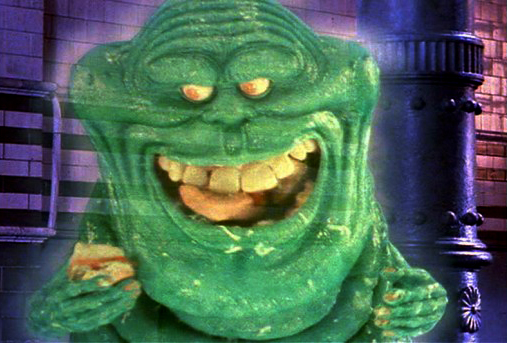
Slimer, also known as "the spud," was a ghost made up of pure ectoplasm and the first ghost successfully captured by the Ghostbusters. Slimer is well known for his gigantic appetite and the slime he leaves behind when he passes through solid objects.
Throughout the first film he appears to lack intelligence and was all about getting a good snack. It was a normally shy ghost but is not afraid to slime when cornered. In the second movie, it appears that Slimer got smarter and could drive a bus. So far, in the video game and cartoon he has gotten smarter and seems to understand basic human concepts.
Slimer was a legendary ghost to all on the original staff of the Sedgewick Hotel. His usual territory was the twelfth floor, but his outings were usually non-violent and simply involved eating food. As a result, the hotel was able to keep a lid on the supernatural problems (for a while). For some reason, Gozer's approaching time of arrival provoked Slimer (and many other ghosts) into being much more active than usual. Eventually the staff couldn't keep the ghost a secret anymore and called the Ghostbusters. However, the Ghostbusters had not yet fully tested their equipment and weren't completely prepared for a full capture. Ray was the first to find Slimer, but missed him and Slimer escaped into the next hall, where he slimed Peter Venkman. After many errant shots and the resulting destruction, Slimer flew into the Alhambra Ballroom where the Ghostbusters made another attempt at capture. Though Slimer is at first tossed around by some more missed shots, the Ghostbusters eventually manage to get him in the streams. Slimer was then caught in the Trap and put in the containment unit. However he was released with the many other ghosts when the storage facility was shut down. Slimer was the final image at the end of the movie, streaking toward the audience shrieking.
Aarons Fav Fictional Characters - Scrat
Scrat is a saber-toothed squirrel who is obsessed with collecting acorns, constantly putting his life in danger to obtain and defend them. He has his own stories in the film, independent of the main plot, which are parallel with the journeys of the other main characters, causing them to interact with him at times.
The character is enormously successful and Scrat is viewed as a breakout character, the most popular of the franchise. In a special feature in the second film's DVD, his name has been stated to be a mix of the words "squirrel" and "rat", his species allegedly believed to have been a common ancestor of both. In the Ice Age DVD commentary, he is referred to as "The Scrat" by directors Chris Wedge and Carlos Saldanha. Scrat is never referred to by name in the films. He is only named in the credits.
Scrat is voiced in all Ice Age movies and short films by director Chris Wedge. He directly interacts with the story's main characters on six occasions. In the first film, he attacks Sid when the latter tries to eat his acorn, successfully regaining it, and later appears when Manny asks him for directions to where the baby's family is and Diego kicks Scrat away before he could tell about nearby saber-toothed tigers. At the end of the second film, Scrat creates a hole in the valley and releases all the melted ice. He later attacks Sid for saving his life (when he had already died and gone to paradise and was about to get a giant acorn). In the third film, Scrat is stepped on by Manny and falls onto Sid's head while chasing his acorn. Finally, he appears when Sid's "children" are batting a ball around, the ball actually being Scrat.
Scrat constantly hunts for his acorn either to bury it or eat it, but fate always gets in the way. He invariably ends up in humorous or painful situations: being struck by lightning, pursued by avalanches, and repeatedly knocked unconscious while fighting for his acorn. Yet he never gives up. Scrat generally loses, except when he defeats a school of piranhas and successfully battles Sid for his acorn.
Scrat appears in Ice Age: Dawn of the Dinosaurs, where he constantly interacts with a female saber-toothed flying squirrel named Scratte, being torn between his love for her and the acorn. In the end, he chooses his acorn. An accident causes him to lose the acorn once again, but he seems to find a new one by the time of the fourth film.
Scrat also appears in Ice Age: Continental Drift when he finds a map leading to a mysterious acorn island, and he goes on a journey to find the island. At the end of the film, he finds 'Scratlantis', an island populated by sabre-toothed squirrels and filled with nuts. However, Scrat proves to be the uncivilized of the sabre-toothed squirrel population, grabbing many nuts and eventually pulling out a giant one, causing Scratlantis (and all the water underneath the island) to be sucked down into a giant hole, leaving Scrat in the middle of a newly created land: the desert.
Scrat is supposedly the only character to survive the ice age, as at the end of the first movie he was frozen in ice. He thaws out 20,000 years later on a tropical beach, where he causes an eruption.
Scrat is the main character in three short films. In the first, Gone Nutty, he loses his collection of acorns in a catastrophic chain of events. He jams his acorn into a hole in the middle of the collection, which shatters the pile and with it the entire continent - which begins the continental drift.
In the second film, No Time for Nuts, Scrat finds a time machine left by a time-traveler and visits several historical events. He becomes trapped in a frightening future when oak trees have become extinct, but somehow manages to return to the series' time period.
A third Scrat short, Scrat's Continental Crack-up, was released in 2010 accompanying the feature Gulliver's Travels, and later with Rio as a promotion for the fourth Ice Age movie Ice Age: Continental Drift.
Scrat also has a cameo in Surviving Sid which was important to the plot.
Scrat is the main character in the Ice Age: The Meltdown video game. He is also playable in the other two games based on the series.
Scrat also made a cameo appearance in the Family Guy episode Sibling Rivalry when Peter Griffin said Scrat's nuts were his, as a result, Scrat pounces and attacks Peter as he was going to steal his nuts.
The origin of Scrat is disputed. Cartoon designer Ivy Supersonic claims she created the character in 1999, after seeing a squirrel-rat hybrid in Skidmore College's Case Green. She called her character "Sqrat" and says she presented the idea to 20th Century Fox movie executives. A CNN report by Jeanie Moos of Ivy's discovery was aired in 2000, two years before Ice Age went into development. Supersonic claims the studio's own documents actually identified the character in Ice Age as "Sqrat", though her creation was not sabre-toothed.
Ivy Supersonic was offered a $300,000 settlement by Fox Studios. She turned it down and subsequently lost in court. The case is currently in appeal (Case # 04401 Court of Appeals, Second Circuit, NYC). She still has hopes of receiving damages for her claimed infringement.
Supersonic did win a partial summary judgement from the Trademark Trial and Appeal Board in a reverse suit, Fox Film Corporation v. Ivy Silberstein (her real name), in which Fox had tried to prevent her from registering the trade mark "SQRAT".
According to Wedge, artist Peter de Seve came up with the design for Scrat after a visit to the Museum of Natural History. Wedge called it "sort of a squirrel based on some lemur."
While initially created as a fictional species for comedic purposes, in 2011 scientists have discovered a mammal quite similar to Scrat. The newly described taxon, Cronopio dentiacutus wasn't a true squirrel nor it did live in Cenozoic era. Instead it was a dryolestoid a group of mammals distantly related to therians and it lived around 100 million years ago in Patagonia. The precedence of the animated character to the discovery of the real one is an example of what is known as the "Dim Effect".

Aarons Fav Fictional Characters - Crocodile Dundee
"Crocodile" Dundee is a 1986 Australian comedy film set in the Australian Outback and in New York City. It stars Paul Hogan as the weathered Mick Dundee and Linda Kozlowski as Sue Charlton.
Inspired by the true life exploits of Rodney Ansell, the film was made on a budget of under $10 million as a deliberate attempt to make a commercial Australian film that would appeal to a mainstream American audience, but proved to be a worldwide phenomenon. Released on 30 April 1986 in Australia, and on 26 September 1986 in the United States, it was the second-highest-grossing film in the United States in that year and went on to become the second-highest grossing film worldwide at the box office as well.
There are two versions of the film: the Australian version, and the American/international version, the latter of which had much of the Australian slang replaced with more commonly understood terms, and was slightly shorter. The international version also changes the title to "Crocodile" Dundee, adding the quotation marks. The film was followed by two sequels: "Crocodile" Dundee II (1988) and Crocodile Dundee in Los Angeles (2001).
Sue Charlton (Linda Kozlowski), a feature writer for Newsday engaged to marry her editor, Richard (Mark Blum), travels to Walkabout Creek, a small hamlet in the Northern Territories of Australia to meet Michael J. "Crocodile" Dundee (Paul Hogan), a bushman reported to have lost a leg to a Saltwater Crocodile. On arrival, she finds his leg is not missing, but has a large scar.
At first Sue finds Dundee less legendary than she had been led to believe, being unimpressed by his uncouth behaviour and clumsy advances towards her; however, she is later amazed when in the Outback, she witnesses "Mick" (as Dundee is called) subduing a Wild Asian Water Buffalo, taking part in an Aboriginal tribal dance ceremony, killing snakes with his hands, and (at her request) scaring tourists from their sport of shooting kangaroos. Offended by Mick's assertion that she is incapable of surviving the Outback alone, Sue goes out alone to prove him wrong, but is attacked by a crocodile and rescued by Mick. She finds herself becoming attracted to him.
Sue invites Mick to return with her to New York City on the pretext of continuing the feature story. There he is perplexed by New York behaviour and customs but is still able to overcome problematic situations including attempted robberies and two encounters with a pimp. When Richard proposes marriage to Sue at a dinner party, Mick is upset and decides to go 'walkabout' around the USA; but Sue, having refused Richard, follows him to a subway station. There, she cannot reach him through the crowd on the platform, but has members of the crowd relay her message to him, whereupon he walks to her on the heads and raised hands of the jubilant crowd and embraces her.

Aarons fav Fictional Characters - Predator
Predator is a 1987 American science fiction action film directed by John McTiernan, starring Arnold Schwarzenegger, Carl Weathers, Jesse Ventura, and Kevin Peter Hall. It was distributed by 20th Century Fox. The story follows an elite special forces team, led by 'Dutch' (Arnold Schwarzenegger), on a mission to rescue hostages from guerrilla territory in Central America. Unbeknownst to the group, they are being hunted by a technologically advanced form of extraterrestrial life, the Predator. Predator was scripted by Jim and John Thomas in 1985, under the working title of Hunter. Filming began in April 1986 and creature effects were devised by Stan Winston.
The film's budget was around $15 million. Released in the United States on June 12, 1987, it grossed $98,267,558. Initial critical reaction to Predator was mixed, with criticism focusing on the thin plot. However, in subsequent years critics' attitudes toward the film warmed, and it has appeared on a number of "best of" lists. Two sequels, Predator 2 (1990) and Predators (2010), as well as two crossover films with the Alien franchise, Alien vs. Predator (2004) and Aliens vs. Predator: Requiem (2007), have been produced.
During the opening credits an alien spacecraft passes by Earth and jettisons something which descends into the atmosphere.
Some time later, Major Alan "Dutch" Schaefer (Arnold Schwarzenegger) arrives in an unnamed country with his elite team for an operation to rescue a presidential cabinet minister and his aide who had been abducted by guerrilla forces. Dutch's old military buddy, now working for the CIA, George Dillon (Carl Weathers), steps in as a liaison and joins the team: Mac Eliot (Bill Duke), Blain Cooper (Jesse Ventura), Billy Sole (Sonny Landham), Jorge "Poncho" Ramirez (Richard Chaves), and Rick Hawkins (Shane Black). The team is inserted into the jungle by helicopter and begins its hunt.
They soon find the wreckage of a downed helicopter, and later, the remains of Army Special Forces unit, whose presence in the country mystifies Dutch, and also shocks them that the bodies are found to be hanged and their skin removed. They track the guerillas to a heavily defended rebel encampment which they destroy, except for a woman named Anna (Elpidia Carrillo) whom they take prisoner. Dutch is enraged when Dillon confesses the rescue mission had been a ploy to get his group to attack the camp and that the men they found earlier had disappeared in a failed rescue of two CIA agents. As the team make their way to the extraction point, they are observed from afar by an unknown creature using thermal imaging.
Anna briefly escapes, but when Hawkins catches her, he is seized and dragged off. The nearly invisible creature spares the unarmed Anna. Moments later, while the team is looking for Hawkins' killer, Blain is killed. Mac physically sees the creature and opens fire on it, but it disappears into the jungle. Anna offers the team insight on the creature which is something of a local legend. The team sets a trap, but it avoids capture, severely wounding Poncho in the process. Mac and Dillon are killed in the ensuing chase, and Billy is slain making a stand. The Predator catches up to Dutch and engages in a short shootout during which Poncho is killed. Realizing the creature only attacks those possessing weapons, a wounded Dutch sends Anna unarmed to the extraction point. Jumping off a waterfall, he narrowly escapes the creature by inadvertently masking his body's heat signature with mud and witnesses the Predator's true form when its active camouflage fails in the water. Dutch applies more mud, improvises various weaponry and traps, then baits the Predator into coming out by starting a large fire.
Hearing Dutch's war-cry, the Predator arrives to investigate and eventually traps him. Discarding its electronic weaponry, the alien challenges Dutch to hand-to-hand combat. Battered and barely able to move, Dutch manages to drop the counterweight from one of his traps, which falls and crushes the creature. As Dutch asks the mortally wounded alien what it is, the creature mimics his question in garbled English and then activates a self-destruct mechanism on its wrist device while laughing, gradually increasing its laugh into a human-like pitch. Dutch barely escapes the massive explosion and is later rescued by helicopter along with Anna.

Aaron fav Fictional Characters - Eddie
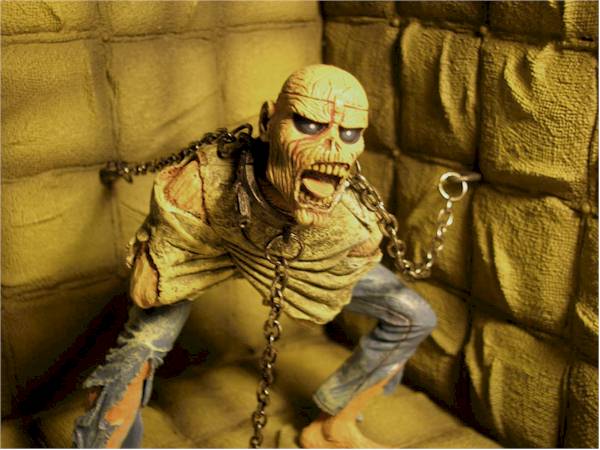
Eddie, also known as Eddie the Head, is the mascot for the British heavy metal band Iron Maiden. He is a perennial fixture of the group's artwork, appearing in all of their album covers (as well as most of their singles) and in their merchandise, which includes t-shirts, posters and action figures. On top of this, Eddie features in all of the band's concerts, as well as in the first-person shooter video game, Ed Hunter, and as an unlockable character in Tony Hawk's Pro Skater 4.
Originally a papier-mâché mask used in Iron Maiden's stage backdrop, the band transferred the name "Eddie" from the mask to an illustration by Derek Riggs, which was used as the band's debut album cover. Although he is occasionally described as "zombie-like" in the press, Eddie assumes a different guise relating to the themes of individual albums and their corresponding world tours, and has appeared as a cyborg, an Egyptian mummy and a lobotomised mental patient amongst others.
The very first version of Eddie was a mask made by an art student who was friends with Dave (Lights) Beasley, then in charge of lighting, pyrotechnics and other effects for Iron Maiden's live-show. According to Lights, the original mask was a papier-mâché mould of his own face, which was then used in the band's backdrop, consisting of LED lights and the band's logo. At the end of their live set, during the "Iron Maiden" song, a fish-tank pump was used to squirt fake blood out of the mask's mouth, which typically covered their drummer, Doug Sampson. After this initial incarnation, Lights constructed a larger mask out of fibreglass, equipped with flashing eyes and the ability to release red smoke from its mouth.
The band's bassist and founder member, Steve Harris, states that the name "Eddie" comes from the fact that said mask was referred to as "The Head", which sounded like "Ead" in the band members' London accent. According to guitarist Dave Murray the name was also inspired by an old joke:
"A wife had a baby, but it was born with only a head and no body. 'Don't worry,' says the doctor. 'Bring him back in five years time and we'll probably have a body for him'. So five years go by, and there's Eddie the 'Ead, as his parents have called him, sitting on the mantelpiece, when in walks his dad. 'Son,' he says, 'today's a very special day. It's your fifth birthday and we've got a very special surprise for you.' 'Oh no,' says Eddie. 'Not another fucking hat!'"
Once Iron Maiden had secured a record contract with EMI, the band's manager, Rod Smallwood, decided that the band needed "that one figure who utterly stamped his presence and image on the band in a way that was obvious enough to make a good album cover." After seeing some of his artwork on a Max Middleton poster, Smallwood set up a meeting with Derek Riggs and asked to see some of his other illustrations, in the midst of which was the band's first album cover. Originally created as an idea for a punk record, which Riggs states in the 12 Wasted Years documentary was based on an alleged American's skull stuck to a Vietnamese tank, the band had extra hair added to the illustration, making it more suitable to their style of music, and transferred the name from the original masks they used onstage. Surmising that the creature had "great visual continuity," Smallwood decided it would be used for all of the band's artwork. Smallwood claims that Rupert Perry, EMI's then managing director, came up with the idea that Eddie could become a more active part of the band's concerts, originally portrayed by Smallwood himself, wearing an Eddie mask and a leather jacket. The classic "walk-on" Eddie was created for The Beast on the Road tour by Dave Lights after seeing a pantomime version of Jack and the Beanstalk, which used similar giants consisting of "basically a bloke on stilts but dressed up to look about ten feet tall." As the band's stage show expanded, an additional gigantic Eddie was also incorporated at the back of the set during "Iron Maiden", which, like the "walk-on" Eddie, would match the theme of the current tour, such as the 30-foot, mummified version used during the World Slavery Tour which shot sparks from its eyes.
Eddie's debut appearance was on the band's first single cover, "Running Free," in which his face was covered by shadow to protect his identity before the release of the band's first album. Since then, Eddie has assumed a different guise for each cover, such as a "mummified Egyptian god" for Powerslave, a lobotomised mental patient for Piece of Mind, emerging from a grave in Live After Death, and a cyborg for Somewhere in Time.

Links To More Images
https://www.google.co.uk/search?q=eddie+iron+maiden&oe=utf-8&aq=t&rls=org.mozilla:en-GB:official&client=firefox-a&um=1&ie=UTF-8&hl=en&tbm=isch&source=og&sa=N&tab=wi&ei=MPVyUI29FeeS0QWHjYHwAQ&biw=1024&bih=629&sei=MvVyUM2yDqjB0QWhqICQCw#q=eddie+iron+maiden&um=1&hl=en&client=firefox-a&rls=org.mozilla:en-GB:official&tbm=isch&source=lnt&tbs=isz:l&sa=X&ei=MvVyUK_oFoHA0QWPjYGwCg&ved=0CCEQpwUoAQ&fp=1&biw=1024&bih=629&bav=on.2,or.r_gc.r_pw.r_cp.r_qf.&cad=b&sei=MvVyUK_oFoHA0QWPjYGwCg
Originally a papier-mâché mask used in Iron Maiden's stage backdrop, the band transferred the name "Eddie" from the mask to an illustration by Derek Riggs, which was used as the band's debut album cover. Although he is occasionally described as "zombie-like" in the press, Eddie assumes a different guise relating to the themes of individual albums and their corresponding world tours, and has appeared as a cyborg, an Egyptian mummy and a lobotomised mental patient amongst others.
The very first version of Eddie was a mask made by an art student who was friends with Dave (Lights) Beasley, then in charge of lighting, pyrotechnics and other effects for Iron Maiden's live-show. According to Lights, the original mask was a papier-mâché mould of his own face, which was then used in the band's backdrop, consisting of LED lights and the band's logo. At the end of their live set, during the "Iron Maiden" song, a fish-tank pump was used to squirt fake blood out of the mask's mouth, which typically covered their drummer, Doug Sampson. After this initial incarnation, Lights constructed a larger mask out of fibreglass, equipped with flashing eyes and the ability to release red smoke from its mouth.
The band's bassist and founder member, Steve Harris, states that the name "Eddie" comes from the fact that said mask was referred to as "The Head", which sounded like "Ead" in the band members' London accent. According to guitarist Dave Murray the name was also inspired by an old joke:
"A wife had a baby, but it was born with only a head and no body. 'Don't worry,' says the doctor. 'Bring him back in five years time and we'll probably have a body for him'. So five years go by, and there's Eddie the 'Ead, as his parents have called him, sitting on the mantelpiece, when in walks his dad. 'Son,' he says, 'today's a very special day. It's your fifth birthday and we've got a very special surprise for you.' 'Oh no,' says Eddie. 'Not another fucking hat!'"
Once Iron Maiden had secured a record contract with EMI, the band's manager, Rod Smallwood, decided that the band needed "that one figure who utterly stamped his presence and image on the band in a way that was obvious enough to make a good album cover." After seeing some of his artwork on a Max Middleton poster, Smallwood set up a meeting with Derek Riggs and asked to see some of his other illustrations, in the midst of which was the band's first album cover. Originally created as an idea for a punk record, which Riggs states in the 12 Wasted Years documentary was based on an alleged American's skull stuck to a Vietnamese tank, the band had extra hair added to the illustration, making it more suitable to their style of music, and transferred the name from the original masks they used onstage. Surmising that the creature had "great visual continuity," Smallwood decided it would be used for all of the band's artwork. Smallwood claims that Rupert Perry, EMI's then managing director, came up with the idea that Eddie could become a more active part of the band's concerts, originally portrayed by Smallwood himself, wearing an Eddie mask and a leather jacket. The classic "walk-on" Eddie was created for The Beast on the Road tour by Dave Lights after seeing a pantomime version of Jack and the Beanstalk, which used similar giants consisting of "basically a bloke on stilts but dressed up to look about ten feet tall." As the band's stage show expanded, an additional gigantic Eddie was also incorporated at the back of the set during "Iron Maiden", which, like the "walk-on" Eddie, would match the theme of the current tour, such as the 30-foot, mummified version used during the World Slavery Tour which shot sparks from its eyes.
Eddie's debut appearance was on the band's first single cover, "Running Free," in which his face was covered by shadow to protect his identity before the release of the band's first album. Since then, Eddie has assumed a different guise for each cover, such as a "mummified Egyptian god" for Powerslave, a lobotomised mental patient for Piece of Mind, emerging from a grave in Live After Death, and a cyborg for Somewhere in Time.
Links To More Images
https://www.google.co.uk/search?q=eddie+iron+maiden&oe=utf-8&aq=t&rls=org.mozilla:en-GB:official&client=firefox-a&um=1&ie=UTF-8&hl=en&tbm=isch&source=og&sa=N&tab=wi&ei=MPVyUI29FeeS0QWHjYHwAQ&biw=1024&bih=629&sei=MvVyUM2yDqjB0QWhqICQCw#q=eddie+iron+maiden&um=1&hl=en&client=firefox-a&rls=org.mozilla:en-GB:official&tbm=isch&source=lnt&tbs=isz:l&sa=X&ei=MvVyUK_oFoHA0QWPjYGwCg&ved=0CCEQpwUoAQ&fp=1&biw=1024&bih=629&bav=on.2,or.r_gc.r_pw.r_cp.r_qf.&cad=b&sei=MvVyUK_oFoHA0QWPjYGwCg
Subscribe to:
Posts (Atom)